The Most Dangerous Meeting I've Ever Sat In
Article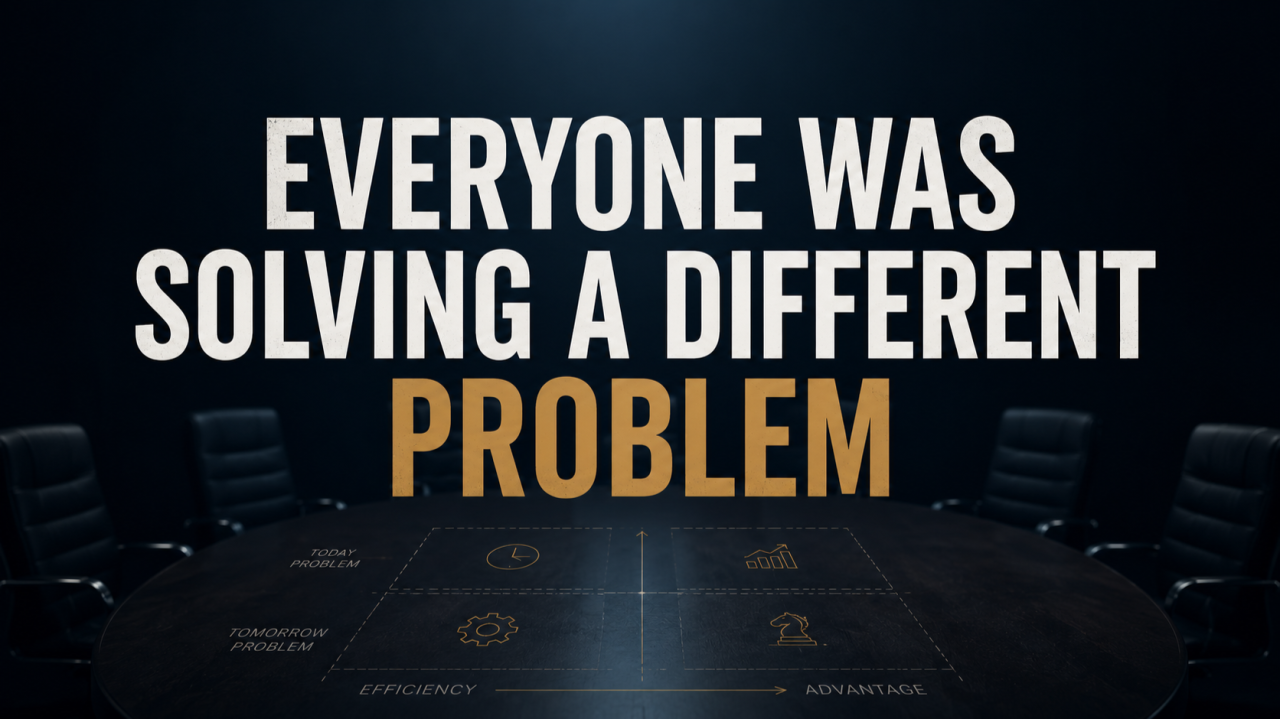
It wasn’t dangerous because people argued. It was dangerous because everyone believed they were solving the same problem.
I’ve sat in hundreds of leadership meetings over the years.
Budget reviews.
Turnaround sessions.
Strategy workshops.
Board updates.
The memorable ones were rarely the loudest.
The most dangerous meeting I’ve ever sat in was almost polite.
The numbers were on the screen.
Revenue was under pressure.
Costs were climbing.
Every person around the table was intelligent, experienced and genuinely trying to help.
Yet after two hours, I realised something unsettling.
Nobody was having the same conversation.
The CFO was trying to protect the business.
Operations was trying to protect efficiency.
Commercial teams were trying to protect revenue.
Creative leaders were trying to protect capability.
Every argument made sense.
Every opinion was valid.
Every recommendation was logical.
The problem was that they weren’t answering the same question.
We often confuse alignment with agreement.
They’re not the same thing.
Agreement is everyone reaching the same conclusion.
Alignment is everyone solving the same problem.
Those are very different things.
When alignment is missing, meetings become exhausting because every participant is optimising for a different outcome.
The finance team talks about margin.
Marketing talks about growth.
Operations talks about utilisation.
Creative talks about quality.
Leadership talks about culture.
All important.
None wrong.
But if no one has agreed on the question the business is trying to answer, every discussion becomes circular.
I’ve started thinking about this through a simple framework.
X Axis:
Are we solving today’s problem or tomorrow’s problem?
Y Axis:
Are we optimising for efficiency or advantage?
Every strategic discussion tends to land somewhere on this matrix.
The tension isn’t that one quadrant is right and another is wrong.
The tension comes when people are standing in different quadrants without realising it.
One leader is trying to reduce cost.
Another is trying to increase capability.
One is preserving cash.
Another is investing for growth.
Neither is irrational.
They’re simply playing different games.
That’s why so many leadership meetings end with action but very little progress.
People leave with tasks.
Very few leave with shared understanding.
Execution improves.
Direction doesn’t.
The best leaders I’ve worked with do something remarkably simple.
Before they debate solutions, they stop and ask:
“What problem are we actually trying to solve?”
Not next quarter’s problem.
Not last quarter’s problem.
This problem.
Because once the question becomes clear, most of the noise disappears.
Trade-offs become visible.
Decisions become easier.
Disagreement becomes productive.
AI won’t solve this.
Better dashboards won’t solve it.
More reporting won’t solve it.
This isn’t an information problem.
It’s a framing problem.
The quality of a leadership team is often determined long before the decision itself.
It’s determined by whether everyone is solving the same problem.
The Bottom Line
Looking back, the most dangerous meetings I’ve attended weren’t the emotional ones.
They were the calm ones.
The meetings where everyone left believing they’d made progress, while the organisation quietly drifted because every function had been rowing towards a different horizon.
I’ve come to believe that one of leadership’s most underrated responsibilities isn’t making better decisions.
It’s making sure everyone is answering the same question.
Because when that happens, good decisions have somewhere to go
Reagen Kok: Business Executive • Turnaround Specialist • Growth Strategist & Entrepreneur