Not All Content Is Equal
Article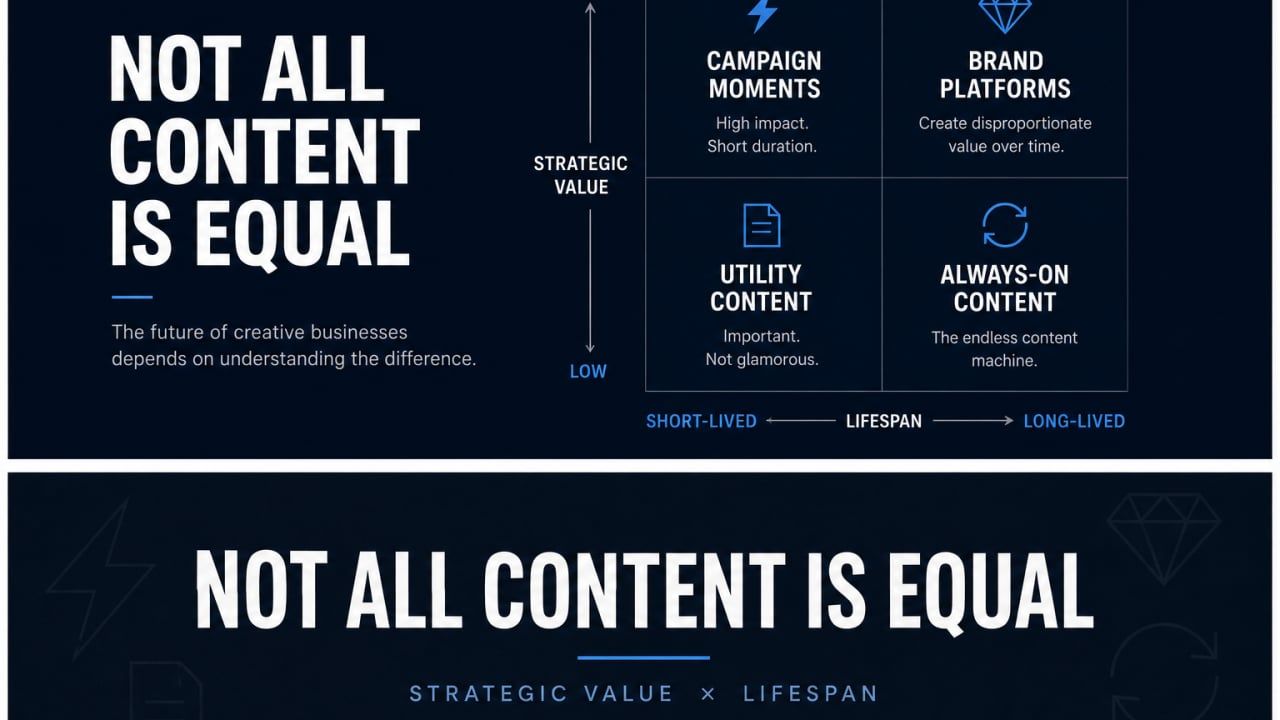
By Reagen Kok
The biggest mistake marketers make is treating all content as if it has the same job. It doesn't. And the future of creative businesses depends on understanding the difference.
A few years ago, “content” became a catch-all term for almost everything we create.
A TV commercial is content.
A TikTok is content.
A product render is content.
A podcast clip is content.
A training video is content.
A brand film is content.
The problem is that while the industry adopted the same label, we never stopped to ask whether these assets were actually performing the same role.
They’re not.
And yet many organisations still brief, approve, budget, and evaluate them as if they are.
I think this is one of the biggest reasons marketing teams feel overwhelmed, production teams feel under pressure, and agencies struggle to maintain profitability.
We’ve created a world where all content sits in the same bucket.
The reality is much simpler:
Not all content is equal.
The Framework
I’ve been using a simple X/Y lens to think about how content creates value.
X Axis:
Lifespan
Short-lived ← → Long-lived
Y Axis:
Strategic Value
Low ← → High
When you map content against these two variables, the picture becomes much clearer.
Quadrant 1: High Value + Long Lifespan
This is where the crown jewels live.
Brand platforms.
Positioning systems.
Foundational brand films.
Category-defining campaigns.
The work that shapes how customers think about a business for years.
Think:
Nike’s “Just Do It”
Apple’s “Think Different”
A distinctive brand identity system
A defining brand story
These assets justify significant investment because they create disproportionate value over time.
The mistake many businesses make is treating these assets as expensive production projects.
They’re not.
They’re strategic infrastructure.
Quadrant 2: High Value + Short Lifespan
These are moments.
Launches.
Activations.
Partnerships.
Sponsorship campaigns.
Seasonal pushes.
They can generate enormous impact, but their relevance is measured in weeks or months rather than years.
The challenge here isn’t quality.
It’s timing.
Perfect execution delivered late is often less valuable than great execution delivered at the right moment.
Quadrant 3: Low Value + Long Lifespan
This isn’t glamorous work.
But it’s essential.
Product explainers.
Training content.
Customer support assets.
Internal communication tools.
The content that quietly keeps organisations functioning.
Nobody wins awards for this work.
But businesses depend on it every day.
Quadrant 4: Low Value + Short Lifespan
This is where most organisations now spend the majority of their energy.
Daily social content.
Adaptations.
Cut-downs.
Platform variants.
Always-on communication.
The endless stream of assets required to remain visible.
Historically, we tried to produce this content using the same operating model we used for high-value strategic work.
That no longer makes sense.
This is where automation, AI, templates, modular systems, and modern production should thrive.
Not because quality doesn’t matter.
Because efficiency matters more.
The Real Opportunity
The future isn’t a debate between creativity and AI.
It’s a debate about allocation.
Where should human ingenuity be concentrated?
Where should technology create leverage?
Where should investment increase?
Where should cost decrease?
The organisations that answer those questions correctly will outperform those that continue treating every piece of content as equally important.
Because every asset doesn’t deserve the same process.
Every brief doesn’t deserve the same investment.
And every problem doesn’t require the same solution.
Production Is Changing
For decades, production was largely measured by effort.
More time.
More people.
More complexity.
More cost.
Today, that equation is breaking.
Technology is reducing effort faster than most business models are adapting.
Which means the future value of production won’t come from how much work is done.
It will come from knowing where work matters most.
The winners won’t be those who create the most content.
They’ll be those who understand the role each piece of content plays inside a larger system.
The Bottom Line
The question is no longer:
“How much content can we make?”
It’s:
“Which content deserves our best thinking?”
Once you understand that, everything changes.
Your budgets change.
Your processes change.
Your teams change.
Your production model changes.
Because not all content is equal.
And the businesses that recognise that first will build a very different future.