The Complexity Trap
Article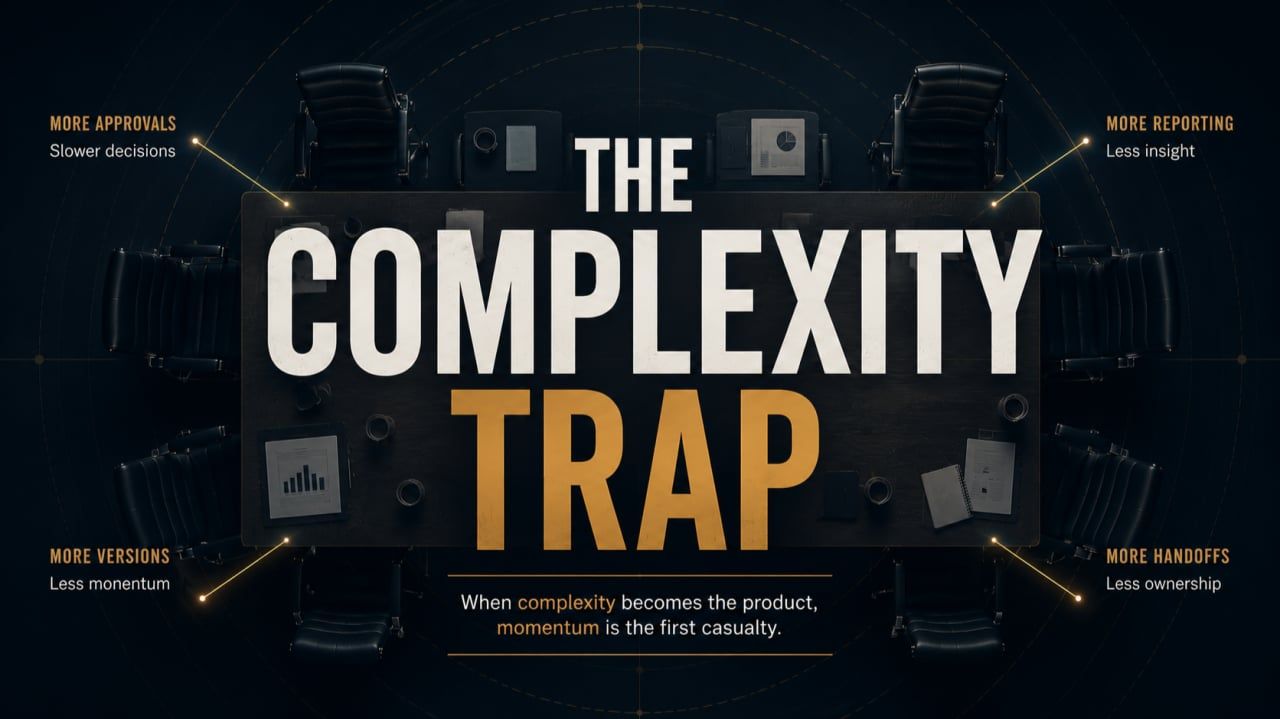
Most organisations don't lose momentum because they stop working hard. They lose it because complexity quietly becomes the product.
A few years ago, I would have told you that the biggest challenge facing creative businesses was finding better ideas.
Today, I’m not so sure.
I think it’s complexity.
Not the complexity of the problems we’re solving.
The complexity we’ve built around solving them.
Every year we add something.
Another approval.
Another report.
Another meeting.
Another version.
Another platform.
Another specialist.
Each decision makes sense in isolation.
Collectively, they create something few organisations ever intend to build.
Friction.
Complexity rarely arrives all at once.
It accumulates.
Quietly.
Almost invisibly.
Until one day, simple work feels surprisingly difficult.
A decision that once took an afternoon now takes three weeks.
A campaign that once required one team now needs six.
A client asks for one change and it travels through half the organisation before anything actually happens.
Nobody designed that system.
It simply grew.
I think about this using two questions.
X Axis
Complexity
Low ← → High
Y Axis
Value Created
Low ↑ High
The interesting conversations happen in the middle.
High Complexity. High Value.
Some work deserves complexity.
Launching a new brand.
Repositioning a business.
Building a global production ecosystem.
Designing a new operating model.
The stakes are high.
The thinking should be too.
Complexity here is an investment.
Low Complexity. High Value.
This is the quadrant I think every organisation should be chasing.
Clear decisions.
Simple processes.
Repeatable systems.
The best businesses I’ve worked with don’t remove rigour.
They remove unnecessary effort.
They understand that simplicity is rarely simplistic.
It’s designed.
High Complexity. Low Value.
This is where organisations quietly become expensive.
Approval layers that no longer add quality.
Meetings that exist because they always have.
Reporting that nobody reads.
Processes built to solve problems that disappeared years ago.
No single piece of this feels significant.
Together, they become a tax on momentum.
Low Complexity. Low Value.
This is where automation belongs.
Templates.
Routine production.
Administrative tasks.
Repeatable workflows.
If humans are still spending disproportionate energy here, we’re asking talented people to solve yesterday’s problems.
AI won’t fix complexity.
In fact, it may expose it.
AI can produce work faster.
It can’t navigate five unnecessary approval layers.
It can generate ideas in seconds.
It can’t resolve unclear ownership.
Technology accelerates systems.
It doesn’t redesign them.
That’s still leadership’s job.
Here’s the question I’ve started asking more often.
If we were building this business today from scratch, would we design it this way?
It’s a deceptively simple question.
Because most organisations aren’t carrying complexity they deliberately chose.
They’re carrying complexity they never stopped to challenge.
The Bottom Line
Every growing business becomes more capable.
The best ones don’t automatically become more complicated.
That’s a choice.
The organisations that outperform over the next decade won’t simply be the ones that embrace AI.
They’ll be the ones disciplined enough to remove everything AI shouldn’t have to work around.
Because the most expensive thing we still produce isn’t content.
It isn’t meetings.
It isn’t technology.
It’s unnecessary complexity.