Everyone wants to be paid on outcomes. Almost nobody actually is
Article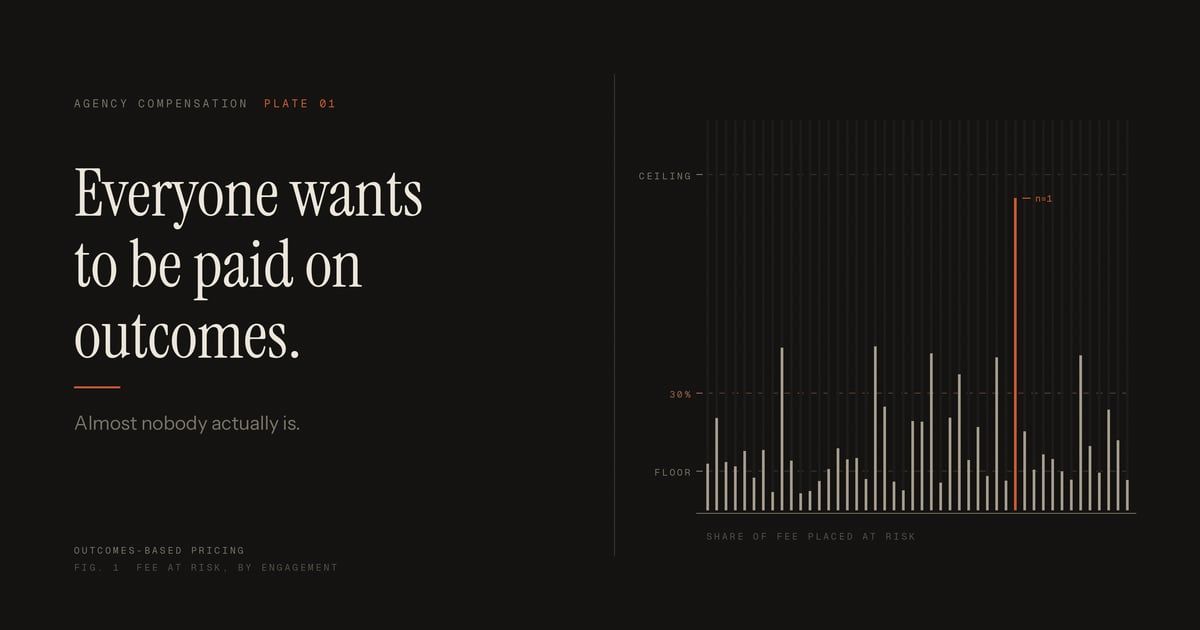
By Edzai Zvobwo
Outcomes-based pricing has become the thing agency leaders say when they want to sound like they have already solved the problem the industry has been circling for a decade. Hourly billing is indefensible, AI is collapsing the hours anyway, so let us get paid for results instead. It is a clean story. The trouble is that the numbers underneath it tell a much messier one.
Mediasense's June study found that 85% of agency leaders expect to increase their use of outcomes-based pricing over the next two years. In the same breath, it found that for more than half of agencies these arrangements still make up less than 30% of client relationships, and that genuinely pure outcomes-based remuneration is, in the consultancy's phrase, "exceedingly rare." Dentsu's iProspect says it is willing to put its whole fee at risk. It currently has no client on a fully outcomes-based model.
That gap between stated appetite and signed contracts is the actual story. It is not a gap that will close on its own, because most of what is holding the model back is structural rather than attitudinal.
We are not all talking about the same thing
Start with the fact that the industry has not agreed on what the word means.
What WPP and iProspect are describing is compensation where a meaningful portion of the fee moves with pre-agreed media or business results. Beat the target, earn above baseline. Miss it, and that slice shrinks. Fair enough, and genuinely different from a rate card.
What a lot of other agencies are describing is an output, a fixed fee attached to a defined set of deliverables, wearing an outcomes label because that is what sells in a pitch. Tracey Shirtcliff of Scope Better puts it plainly: there is a definition problem, and what agencies usually land on is a hybrid, an output fee with a performance layer bolted on top.
This matters more than it sounds. Agencies have been putting slices of fee at risk for years. Performance bonuses are not new. If the 85% figure is mostly measuring enthusiasm for a slightly larger version of something the industry already does, then the revolution being announced is really an incremental shift in percentages. Worth doing, but not the reinvention of agency economics that the conference stage suggests.
You cannot be paid for what you do not control
The second constraint is scope. WPP's Jaguar Land Rover deal ties fees to measurable sales, and it is being watched closely for exactly that reason. But WPP's remit there covers creative, media, production, customer experience and strategic counsel. When you hold that much of the funnel, a sales-linked deal is at least arguable.
Most agencies hold one slice. A creative agency that did not build the site, does not set the price, does not control stock availability and does not run the CRM programme is being asked to carry commercial risk on a system it touches at one point. Broadhead, the Minneapolis independent, has one performance-linked contract with 15% of fees at risk, and it is tied to traffic driven to the client's site rather than to sales, precisely because the agency did not design the site. That is a well-drawn line, and more agencies should be drawing it.
Category matters too. Retail and e-commerce sit best with this model because the transaction volume is high, the conversion point is clear and there is very little sitting between the ad and the purchase. Healthcare and automotive are poor fits, hampered by regulation and long consideration cycles. Any agency in a considered-purchase category that agrees to sales-linked compensation is not taking a calculated risk, it is taking a bet.
And then there is the quiet version of all this. One creative executive, speaking anonymously, described giving up 10% to 20% of fee for the first months of a relationship, recoverable with a bonus if KPIs are met. He was candid that this is about showing skin in the game in a tight pitch rather than any conviction about the model. I would guess that is closer to standard practice than any headline deal.
Attribution is where these deals go to die
Agreeing the outcome is the hardest part of the whole exercise, and the survey data backs that up: 69% of agencies called difficulty agreeing an attribution methodology a critical or strong barrier, and 68% cited insufficient access to client data.
The bind is simple. The metrics that clients care about most, revenue and margin, are the ones agencies control least. The metrics agencies can genuinely move are the ones clients discount as proxies. Every negotiation is a fight over where on that spectrum to plant the flag, and the answer determines who is really carrying the risk.
Acadia's Jared Belsky asks prospective clients for a year of data to model against before agreeing a percentage-of-revenue deal, and runs into marketers who will not share until a contract exists. That chicken-and-egg problem is a trust problem with a data governance costume on.
The technical fixes are real but partial. Incrementality testing is the single most useful tool here and the most under-used. Marketing mix modelling and multi-touch attribution both work, but as Mediasense's Ryan Kangisser notes, they are too slow for contracts that need to settle monthly or quarterly, which is why proxy metrics keep creeping back in. Third-party measurement solves the grading-your-own-homework problem and introduces cost, delay and a new party to argue with. Nobody has a clean answer.
Read the WPP deal carefully
The majority of WPP's fees on JLR are at risk. That sounds like a serious bet until you add the two things sitting alongside it. Cindy Rose has said there are ceilings and floors in the arrangement, and WPP is reportedly permitted to buy JLR media on a principal basis, purchasing inventory and reselling it.
That is not risk elimination, but it is risk relocation, and it is worth being honest about the optics. Principal buying is the practice the ANA transparency work made contentious in the first place. Hedging an alignment-based fee structure with arbitrage margin is, at minimum, an uncomfortable pairing. If outcomes pricing is meant to rebuild trust in how agencies get paid, the mechanism used to make it survivable should probably not be the one that damaged that trust.
The underlying point stands, though, and Kangisser is right about it. Agencies have payroll, and payroll is not variable. Any agency putting real fee at risk needs something predictable underneath it, whether that is a floor, a retainer base or a supplementary revenue line. An agency that agrees to genuine downside with no floor is not being brave, it is being reckless with other people's jobs.
The asymmetry nobody wants to name
Here is the part of the article that should worry agency leaders most.
Belsky recalls a client telling him, in effect, that he was making too much money and should have flagged it.
Wesley ter Haar of Monks describes the same pattern: perform well, earn well, and eventually a new procurement lead or marketing director arrives and reads your success as evidence that you are overpriced.
So the model is asymmetric in practice. Downside gets enforced automatically, because it is contractual. Upside gets renegotiated, because it is political. Once you see that, Acadia's response makes complete sense: caps on performance earnings and reverse tiering, where the agency's percentage declines as results climb.
It also guts the argument for the model. The entire case for outcomes pricing is that it aligns incentives by letting the agency share in the value it creates. Cap the upside and taper the rate, and what you have left is a structure with real downside and a managed ceiling. That is not alignment, it is a discount with extra admin.
Procurement compounds this. Sixty-nine percent of agencies rated procurement teams a critical or strong barrier, and the reason is mechanical rather than adversarial. Procurement's tooling compares proposals against full-time equivalent models. A variable outcome fee cannot be benchmarked against an FTE rate card, so there is no way to demonstrate a saving, and no procurement professional gets promoted for signing something they cannot show a saving on. Mediasense found that even when these models get into the conversation, they tend to be diluted until they look like conventional fee structures again. Of course they do. That is what the evaluation system is built to reward.
The view from here
For South African agencies watching this debate, a few things are worth holding onto.
Our market amplifies most of these constraints. Budgets are smaller, so the absolute rand value of a performance upside is often too thin to justify the measurement infrastructure it requires. Client-side data maturity is uneven, and an outcomes deal is only as good as the data both parties can see. Payment terms of 60 to 90 days are common, and layering variable, back-ended compensation on top of that is a cash flow decision before it is a commercial one. An agency funding several months of salaries against a payment that may or may not arrive is financing its client's growth, which is a role banks are better structured for.
The genuine local opportunity sits where the article says it does, in retail and e-commerce, and that is a growing part of our market rather than a shrinking one. Retail media, quick commerce and DTC categories give you the clean conversion points and the transaction volume that make these deals measurable. If you want to run a performance-linked contract, that is where to start, not on a brand campaign for a considered purchase.
Three practical rules, if you are heading into one of these negotiations.
First, only put at risk what you can influence. Broadhead's ceiling of roughly 20% to 30% is a sensible upper bound for most agencies, and the figure should move with how much of the funnel you actually control.
Second, negotiate the measurement before the money. Agree the baseline, the attribution method, the exclusions for events outside your control, and who arbitrates a dispute. iProspect has gone as far as writing force majeure into compensation terms rather than just service delivery, which is a good instinct in a market that has recently lived through tariffs, currency shocks and a pandemic.
Third, protect the upside as hard as you protect the downside, and build a renegotiation trigger into the contract rather than waiting for an uncomfortable conversation in month fourteen. A deal that only reopens when the client is unhappy is not a partnership agreement.
Rose says broad adoption will take a few years. Mediasense is gloomier, concluding that a full transformation may sit in the distant future, if it happens at all. I would put it slightly differently. Outcomes pricing is not going to replace the fee model. It is going to become a standard component within it, sized to scope, concentrated in measurable categories, and hedged on both sides. That is a less exciting story than the one being told from conference stages, but it is the one that will survive legal review.
This article is based on the article - Agencies want to get paid for outcomes—here’s what’s standing in the way